Why I Built This Place
The Story behind The Garden of Grace and Gratitude
This property has been in my family since the Golden Shores subdivision came on the market over a half century ago. My grandfather had the foresight to purchase several adjacent lots on Pima Parkway. After his death the family gradually sold most of them, but three lots passed to my mother, and from my mother to me before she died.
I did not plan to live here. I came temporarily, to provide a stable address during a custody battle, and stayed. That is how it works sometimes. The place you never intended to stay becomes the place where everything that matters happens.
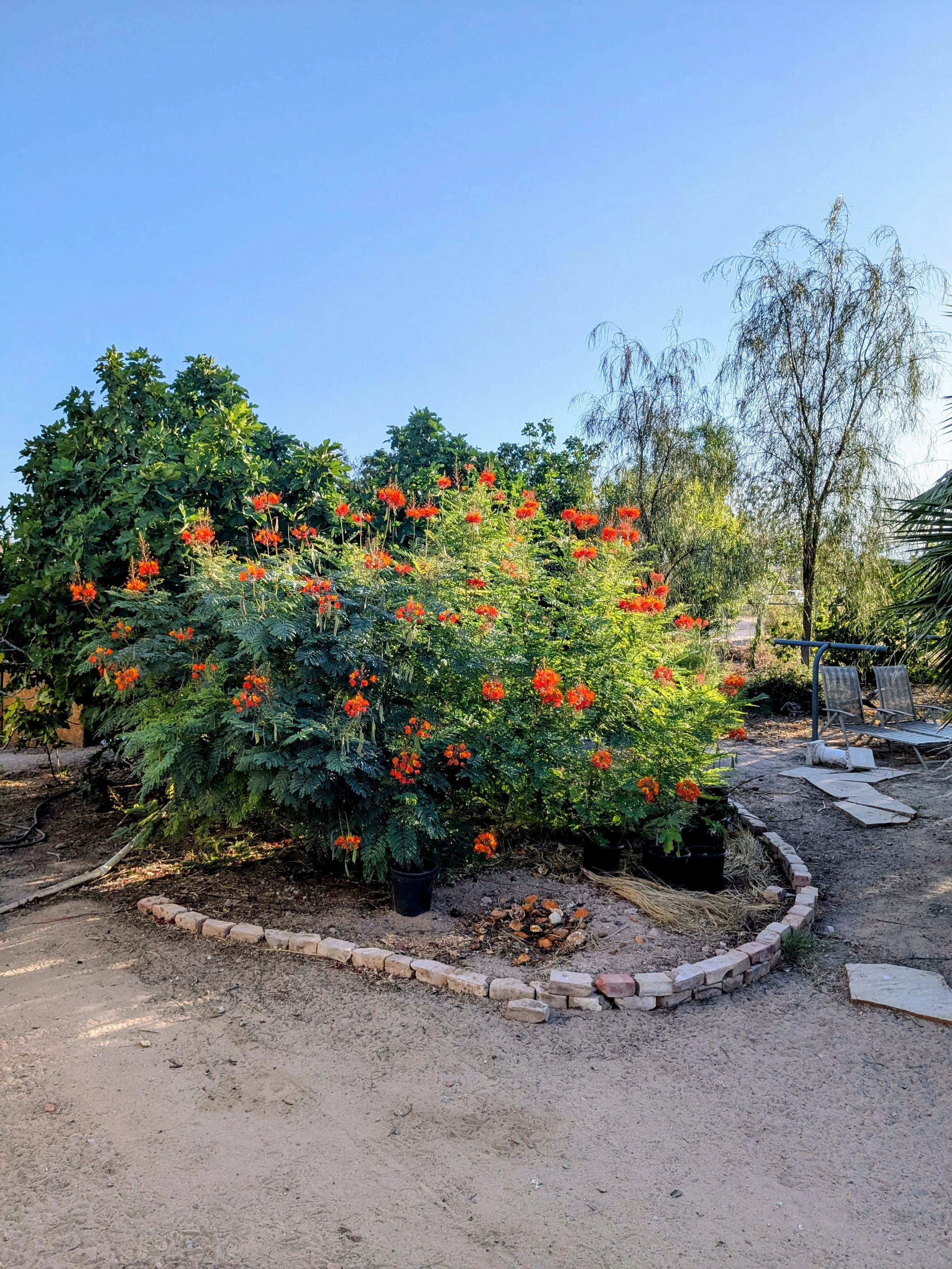
From the time it became clear I was not going back to Southern California, I had a vision. Shade trees, fruit trees, flower and vegetable gardens. A place of green in the middle of the desert. I planted over eighty trees. I built garden beds and a chicken coop. I put down roots in every sense of the word.
The yard that felt overwhelming became the project that healed me.
One section at a time. One day at a time.
After a series of losses - a husband badly burned in a plane crash, family members gone too soon, and finally a catastrophic automobile accident in 2015 that fractured my spine and took years of recovery - the property became something more than a home. It became a place of recovery. For me first. Then for others
People came to stay for a week and remained for months. Some were in crisis. Some were simply depleted. All of them left with something they had not arrived with - a renewed sense of what was possible, a quieter relationship with their own story, something that felt like gratitude even when their circumstances had not changed. They had changed.
That is when I understood what this place was meant to be.
The Garden of Grace and Gratitude is not a medical clinic. It is not a spa. It is a healing environment built on the conviction that the body is designed to recover - and that it does so most effectively when surrounded by natural elements, skilled support, and the kind of unhurried attention that is increasingly rare in modern healthcare.
The pool, the infrared sauna, the therapeutic technologies, the desert air, the eighty trees, the Colorado River five miles to the west - these are not amenities. They are the conditions under which healing actually happens.
I have been in clinical practice since 1978. I have seen thousands of patients. What I know after all those years is this: the body wants to heal. It will do so given half a chance and the right conditions. My job is to provide those conditions and to hold the possibility of recovery when the patient cannot yet hold it for themselves.
That is what this place is for. That is what I built it for.
If you are ready to find out what your body is still capable of: ruth@gracegardenhealing.com GraceGardenHealing.com
What Business Think Tanks are Asking -and What Five Decades of Clinical Practice Answers
Leadership think tanks are starting to ask the right questions.
A recent post in my LinkedIn feed from a prominent leadership community asked its members to choose the skill they believe will be most valuable five years from now. The choices were asking better questions, emotional regulation, strategic thinking, and storytelling.
I chose emotional regulation. Not because the others don't matter — they do. But because they all depend on it.
Here is what I have observed across nearly five decades of clinical practice: when a person's nervous system is chronically dysregulated — whether from accumulated physical trauma, unresolved emotional experience, or the chemical consequences of how we are eating and living — their capacity for every other skill on that list is compromised. The strategic thinker who cannot manage their emotional state under pressure makes poor decisions at exactly the moments when good ones matter most. The storyteller who has not done the inner work tells stories that don't land because they don't carry the weight of genuine self-knowledge. The person asking better questions shuts down the moment they feel threatened rather than curious.
Emotional regulation is the soil in which every other leadership capacity grows. And like soil, it is something that has to be cultivated deliberately — it doesn't simply appear because someone is intelligent, experienced, or well-credentialed.
What the business world is beginning to name as a leadership skill, the clinical world has been treating as a health necessity for decades. A nervous system that cannot regulate itself is not simply less effective at work. It is less healthy, less connected, less capable of the genuine human presence that leadership — real leadership — requires.
The good news is that emotional regulation is not fixed. It is trainable, restorable, and teachable. The conditions that support it — adequate sleep, nutritional support, physical movement, genuine human connection, environments that communicate safety — are knowable and buildable.
That is what we do at Grace Garden Healing. And apparently, it is what the business world is beginning to realize it needs too.
Ruth Ross, D.C. is an integrative health practitioner and author specializing in trauma recovery and restorative health at The Garden of Grace and Gratitude in Golden Shores, Arizona. GraceGardenHealing.com
WATER and the NERVOUS SYSTEM
Water provides support and stimulation not possible on land
Most people think of water therapy as physical support — buoyancy reducing joint load, resistance providing gentle exercise. That's true as far as it goes. But the research now suggests something considerably more interesting is happening when a person enters a natural water environment for therapeutic purposes.
The nervous system doesn't just tolerate water. It responds to it differently than it responds to any land-based environment.
Here is why. Every movement pattern your body uses on land has been shaped by gravity and by the history of what that movement has cost you — the injuries, the compensations, the habits built around pain and limitation. Your nervous system has learned those patterns and repeats them automatically, even when they no longer serve you. That's not weakness. That's how the nervous system protects you.
Water changes the equation. Buoyancy removes the gravitational demand that triggers the habitual pattern. Resistance provides sensory feedback in every direction simultaneously. The result is a nervous system encountering new movement options it couldn't access on land — not because it was forced to, but because the conditions that made the old pattern necessary have temporarily changed.
Moshe Feldenkrais spent his career trying to recreate this neurological opening through movement sequences on the floor. Water provides it naturally.
There is also a dimension that the clinical research is only beginning to measure but that every practitioner who works in water already knows. The quality of a person's nervous system regulation changes in natural water environments in ways that extend beyond the physical. The sound, the temperature, the light, the sensation of resistance that yields — these engage the brain's aesthetic and sensory systems in ways that support genuine parasympathetic activation. The body shifts from threat response toward healing response not because it was instructed to, but because the environment itself communicates safety.
At The Garden of Grace and Gratitude, the pool is not a piece of equipment. It is a therapeutic environment. What happens there is neurological re-education through the medium of water — and the results consistently exceed what the physical description of the modality would predict.
If you have been told your limitations are permanent, I would invite you to come and experience what water can do that land cannot.
Book a consultation at GraceGardenHealing.com
LIFE IS NOT A DEBATE
When winning becomes the goal, we stop listening . . .
When winning becomes the goal, we stop listening and start preparing our next argument. We treat every conversation like a courtroom — looking for weaknesses, building our case, waiting for our turn to speak. Life becomes a contest rather than a collaboration, and somewhere in that shift, depth, understanding, and genuine meaning slip away.
Bradley James Davies, whose forthcoming book on listening is one of the most timely works I've encountered, names this pattern with precision. Most people listen to respond rather than to receive. The result is a kind of relational poverty — we are surrounded by people and yet perpetually unheard, and perpetually failing to truly hear.
What I want to add to this conversation, from four decades of clinical practice, is something that doesn't often enter the discussion: the neurological and physiological dimensions of why people stop listening.
The collision of poor listening with the conditions of modern life is not always a character flaw. It may be a neurological insult — the residue of accumulated physical and emotional trauma that has left the brain less capable of the sustained, open attention that genuine listening requires. I call this the trifecta of trauma: the physical, emotional, and chemical layers of damage that stack invisibly over a lifetime and quietly erode our capacity to be present with another person.
Physical injury is the easiest to acknowledge. A cast draws signatures. People notice when it comes off. Even the residual limp gets addressed — a sharp physical therapist retrains the gait, restores the normal pattern. We give physical healing the dignity of being seen.
But the emotional and neurological limp? That one often goes undiagnosed for decades, showing up not as a visible wound but as a person who interrupts, argues, defends, or simply stops listening — in the boardroom, at the dinner table, in the therapy office.
The workplace implications are significant. When an organization's culture is built around debate rather than collaboration, it rarely reflects a failure of values. It often reflects a collection of people carrying unaddressed neurological and emotional load — people whose capacity for genuine listening has been quietly depleted by experiences they were never supported to process.
This is treatable. The limp can be addressed. The brain can be retrained.
That is the work.
At Grace Garden Healing we listen: 760-326-6544
WHY HEALING BEGINS WITH FEELING . . . .
Most people who struggle don't know why. The answer is often not in the body or the circumstances — it's in the emotional layer underneath. Here's what the science says, and what it means for your recovery.
Most people who come to me aren't sure what's wrong. They know something isn't working — in their body, their relationships, their ability to move through life the way they once did or the way they know they could. They've often been told the problem is physical, or situational, or simply age. What rarely gets examined is the emotional layer underneath.
For decades, researchers assumed that intelligence — IQ — was the primary predictor of a person's success, resilience, and capacity for connection. In 1990, two psychologists named Mayer and Salovey demonstrated something different. They identified a distinct set of mental abilities they called emotional intelligence: the capacity to accurately perceive emotion, to use emotional information productively, to understand how emotions work, and to manage them in a way that serves life rather than sabotages it.
Trauma disrupts all four of these abilities.
When something overwhelming happens — whether it happens once or accumulates over years — it changes how a person reads emotional information, in themselves and in others. It narrows the vocabulary available for understanding internal experience. It makes the regulation of emotion feel impossible rather than learnable. And because these disruptions happen below the level of conscious awareness, most people don't know they've lost something. They just know that life feels harder than it should.
The body keeps score, as the saying goes. But so does the emotional system. And just as the body can recover function it was told was gone for good, the emotional system can rebuild abilities that trauma damaged — given the right conditions, the right support, and the willingness to look honestly at what's actually there.
That is the work I do at Grace Garden Healing. Not managing symptoms. Restoring capacity.
If something in this resonates with your own experience, I'd welcome a conversation.
Book a complimentary consultation at GraceGardenHealing.com
KNOWING YOUR COLORS
What a color consultation taught me about making decisions in every area of life — and why knowing your criteria changes everything.
Forty years ago a dear friend and I had our colors done at a home party. You may remember the era — everyone gathered while a consultant draped fabric swatches over your shoulders and declared what season you were. I came out an Autumn. Teal and rust were my colors. Gray and burgundy were not.
I didn't fully appreciate what that meant until I went home and looked at my closet. Hanging there was a gray wool suit I had spent a small fortune on in 1979. Beautiful fabric. Perfect fit. And every single time I wore it, someone would say "What a great suit" — immediately followed by "Are you feeling okay?" I looked sickly in it. I just hadn't known why until someone held the right colors up to the light.
That afternoon changed how I shop. But more importantly, it changed how I think about decisions.
Here is what I learned that day that has nothing to do with clothing: without knowing what actually fits you, every rack looks the same. Every option seems equally possible. You bring things home that look reasonable in the store and wonder later why they never quite work.
The colors consultation gave me a filter. And a filter changes everything — not because it limits your options, but because it focuses them. When you know your criteria in advance, you stop wasting time on what was never going to suit you.
I've watched this principle work in every area of life I've paid attention to. When my daughter was eighteen, walked onto a car lot and rattled off every feature she wanted. The salesman came back in minutes with exactly the right car. She'd had years of road trips to think about what a vehicle actually needed to do. She had criteria. She knew her colors.
Another friend was building a beautiful home and his wife asked him to help choose kitchen cabinet knobs. After working through the style, she asked which of ten back plates he preferred. He told her to choose whatever she liked and send him the bill. He had no criteria for cabinet hardware — and knowing that saved him hours of misery.
The question worth sitting with is this: in the areas of your life that feel most uncertain or exhausting — your relationships, your work, how you spend your time and energy — do you know your colors? Do you have a filter, a set of honest criteria, that tells you quickly what fits and what makes you look sick?
If not, that's where the real work begins. Not in making better choices, but in knowing yourself well enough to recognize one when it's standing in front of you.
To schedule a complimentary consultation: ruth@gracegardenhealing.com
On Forgiveness -
And Why I Could Not Do It From a Distance
A few months ago I was talking with my daughter about a difficult situation - a friendship of over forty years that had ended badly. A significant betrayal. Real financial loss. And my handling of it, which I had always justified as righteous and honest.
My daughter listened. Then she said, gently but without softening, that I could have handled it differently. Not that I was wrong. That I had choices, and I was responsible for the choice I made and its consequences.
I wanted to defend myself. She would not hear it. She just kept returning to the same point: I had choices.
Seven years had passed since the betrayal was discovered. Nothing had changed on the other person’s end. I was still out a significant amount of money. I had received no explanation. I had been vilified for bringing the situation to light. The circumstances were exactly as they had been.
What had changed was me.
I had the heartfelt desire to forgive her. Not because the circumstances had improved. Not because I had received an apology. But because I was ready to put it down.
I had been praying the Lord’s Prayer for years without fully registering what it asks of us. Forgive us our trespasses as we forgive those who trespass against us. That is not a request. It is a condition. When I finally sat with that honestly, I understood that forgiveness is not optional if I want to be forgiven myself.
Here is the harder admission. I told myself I was willing to write a letter not just of forgiveness but an apology for even accusing her. I was even willing to take the accusation and the judgment off the table. (Even in the face of undeniable evidence to the contrary) But as I wrote this, I realized I was not willing to see her again, because that would put my forgiveness to the test. And that told me everything I needed to know about how complete my forgiveness actually was.
Real forgiveness has to be delivered in person. That realization brought me to tears.
I share this because the people who come to me are almost always carrying something they have not forgiven - someone else, a circumstance, or themselves. The body carries what the heart refuses to put down. That is not metaphor; that is physiology.
We all make the best choices we can at the time with the resources we have. The people who wrong us do so from a background we do not fully know. We judge their actions through our own experiences, our own knowledge, our own pain - not theirs.
Start with the easier things. Realize you have the power of choice. Build the inner quiet that gives you time to consider your options before you react. Each time you make a more forgiving choice, notice what it does to you. There is a kind of power in it that resentment cannot produce.
Forgiveness is a lifelong practice. But it begins with one thing you are holding and willing to put down. Don’t be concerned about choosing the right one - are all the right one.
To schedule a complimentary consultation: ruth@gracegardenhealing.com
We Can Never Get Enough
…. of What We Don’t Need
There is a principle I keep returning to in my clinical work, and it is this: when we get what we actually need, we are satisfied. When we pursue what we don’t need, no amount of it is ever enough.
This is easiest to see in nutrition. A meal built on real protein, healthy fat, and whole food provides a long, slow source of energy. A meal of refined carbohydrates gives a brief surge followed by a crash - and leaves you reaching for more before the plate is cleared. The body is not confused. It knows what it needs. The problem is we have learned to offer our body substitutes
The same principle operates in every other area of life.
No amount of supplements will replace real nutrition.
No material wealth will resolve a genuine sense of low self-worth.
And no amount of technology will fill our need to connect with other people face to face.
After my husband passed, I noticed something in myself. I kept returning to a particular kind of entertainment - stories about two people of different worlds who overcome every obstacle to find each other. I watched a great many of them. They helped, for a moment. Yet, no amount of cinema filled the actual hole in my heart. Only real relationships do that.
I eventually came to grips with what I was actually seeking. Connection. Presence. Someone who knows Me and stays anyway. Those things cannot be streamed.
There is also no replacement for time in nature. Whether it is your hands in soil, bare feet on grass, or simply sitting outside in the evening air - contact with the natural world has measurable effects on the body’s frequency and nervous system regulation. This practice even has a name now: grounding. The research behind it is solid.
At The Garden of Grace and Gratitude, the environment itself is part of the therapy. Eighty trees. Desert air. The pool of faith and hope filled with natural water. The Colorado River five miles to the west. These are not decorations. They are conditions under which the nervous system begins to settle and the body begins to remember what it is capable of.
The question worth asking yourself is this: “What am I reaching for that is not acturally satisfying me? What genuine need is underneath it?
That is usually where the real work begins.
To schedule a complimentary consultation: ruth@gracegardenhealing.com
What Happened When I Just Walked
A client shares her experience at
The Garden of Grace and Gratitude
I want to be upfront about something before I tell you this story. My name is Denise, I am a friend of Dr. Ruth Ross. I was not at her pool for therapy. I was there for fun, relaxation, and to enjoy the water on hot Arizona afternoons. I say this so you understand that what happened to me was not the result of a directed program. It was a side effect of simply being there.
Three years ago I could barely walk. Knee pain, hip pain, terrible balance. I struggled on stairs. I could not walk in a straight line without concentrating. I was 69 years old, a former dancer, and I was convinced I had arthritis and that my future held progressive limitation.
Then I met Dr. Ruth. She introduced me to nutritional supplements, encouraged me to eat whole foods, to move more, to spend time in nature. Over three years I improved steadily. My walking improved. My stair climbing improved. I felt better than I had in years.
Dr. Ruth has an uncanny way of knowing what someone
needs and when someone can do more. When you think
you’ve done all you can, she gives you that little push
to do just a little bit more.
But something changed in the last three months specifically. And it is directly connected to the therapy pool at the Garden of Grace and Gratitude.
What did I do in that pool? I walked. That is it. Back and forth in the water, about 90 minutes, three days a week. I floated a little. I swam a little. But mostly I just walked. And here is the thing - I walked for 90 minutes and did not think about stopping. I was not in pain. I did not get winded. I was not even tired when I finished.
The improvement in my walking and balance over those three months has been more significant than in the two and a half years before it.
I am telling you this because if a pool visit for fun and relaxation produced these results for me, I genuinely wonder what a directed therapeutic program would do for someone whose need is greater than mine was.
I was not a patient. I was a friend in the water. I walked away changed
This testimony was written in Fall of 2024 and was first published in the local paper
To schedule a complimentary: ruth@gracegardenhealing.com